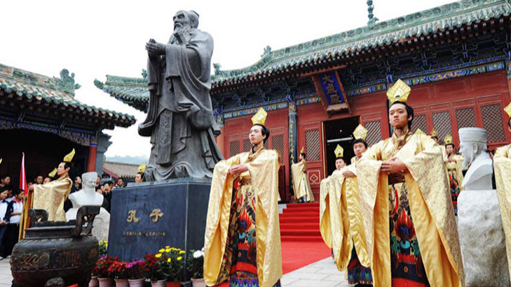
Temple and Cemetery of Confucius and the Kong Family Mansion in Qufu
Introduction
Confucius, a renowned philosopher, politician, and educator in ancient China, developed a system of beliefs known as Confucianism, which has profoundly influenced Chinese culture. Confucius is honored in his birthplace, Qufu city, Shandong province, China, through the Temple of Confucius, established in 478 BC. Despite being destroyed and rebuilt multiple times, the temple now spans 14 hectares, featuring 104 buildings from the Jin (1115-1234) to Qing (1644-1911) dynasties, including the Dacheng Hall, Kuiwen Pavilion, and Xing Altar, and over 1,250 ancient trees. The temple houses more than 1,000 stelae, Han stone reliefs, carved pictures of Confucius' life, and stone dragon carvings from the Ming (1368-1644) and Qing dynasties.
Located 1,100 meters north of Qufu city, the Cemetery of Confucius covers 183 hectares and contains Confucius’ tomb along with more than 100,000 graves of his descendants.
East of the Temple lies the Kong Family Mansion, which evolved from a small family house into an aristocratic residence for Confucius' male descendants. After a fire in the 14th century, the mansion was rebuilt near the temple and later expanded. It now covers 7 hectares with around 170 buildings. The Mansion holds over 100,000 artifacts, including ceremonial utensils from the Shang (c.16th century-11th century BC) and Zhou (c.11th century-256 BC) dynasties, various portraits of Confucius, and clothing from the Ming and Qing dynasties. Additionally, it contains more than 60,000 files and archives from the Ming and Qing periods, providing valuable insights into the history of those eras.
The buildings were meticulously designed according to Confucian principles of hierarchy and spatial arrangement. During the Ming period, many skilled artists and craftsmen contributed to the temple's decoration, and in the Qing period, imperial craftsmen built the Dacheng Hall and Gate and the Qin Hall, which are considered masterpieces of Qing art and architecture.
The Temple of Confucius, the Cemetery of Confucius, and the Kong Family Mansion are exemplary representations of oriental architectural skills, holding deep historical significance and forming an important part of the world’s cultural heritage. These sites were added to the World Heritage List in December 1994.
Cultural Heritage
The Temple of Confucius in Qufu has been in use for over 2,400 years. It is the central place for worshippers of Confucius from all over the world and serves as a model for over 2,000 Confucius temples located in China, Korea, Japan, Vietnam, Indonesia, Singapore, the United States, and other places.
The Cemetery of the Kong family, also with a history of over 2,400 years, is one of the oldest cemeteries in the world.
The Family Mansion of Confucius is the largest, most typical, and best-preserved special building complex for both official and private use in China. Its owner, the Kong family, is the most time-honored noble family in China, with peerage titles dating back over 2,100 years.
The historic, scientific, and artistic value of the Temple, Family Cemetery, and Family Mansion of Confucius lie in their impressive collection of cultural relics. In the field of architecture, more than 300 buildings erected through the Jin, Yuan, Ming, and Qing dynasties reflect the characteristics of those different eras. Over 1,000 Han Dynasty (206 BC-AD 220) stone reliefs, inscribed figures of Confucius, and dragon poles illustrate the evolution of the art of stone inscription. Over 5,000 inscribed tablets passed down since the Western Han Dynasty provide a precious showcase of Chinese calligraphy, as well as valuable material for the study of ancient China's politics, ideology, economy, culture, and arts. Some 100,000 tombs bear concrete testimony to China's ancient burial customs.
More than 17,000 ancient and precious trees stand here as living material for research into ancient phenology, meteorology, and bionomics. There are also more than 100,000 collected relics, among which the most famous are rare genuine costumes of the Yuan and Ming dynasties and portraits of Confucius, Lord Yansheng, and their wives, as well as original ceremonial utensils. Researchers studying history, especially the economic history of the Ming and Qing dynasties, cannot miss the 300,000 original files and documents of those times, which comprise the largest private collection of ancient files in China.
Confucius and Confucianism
Confucius (551-479 BC) was China's most famous philosopher, political theorist, statesman, and educator. He was born in the State of Lu towards the end of the Spring and Autumn period, prior to the Warring States, an age of much conflict and unrest. He spent his whole life in the pursuit of learning (xue) and truth, and practiced a self-disciplined life, exerting a far-reaching influence on the mentality of the Chinese people and many other peoples around the world.
Confucius sought learning extensively, from the six arts (ritual, music, archery, charioteering, calligraphy, and arithmetic) to the thoughts of Laozi, or Lao-Tzu, founder of Taoism. He held several posts, from finance officer to minister of justice. He traveled to many states to spread his political thought and set up and presided over the earliest Chinese school open to all classes of people. He was the chief compiler and editor of many historical records, as well as some of the most influential books of Chinese history, including "The Book of Songs" (Shijing) and "The Spring and Autumn Annals" (Chunqiu). His own thoughts are collected in the "Analects of Confucius" (Lun-yu), compiled by his disciples.
Confucius' thought, which centered on ren (humanity or benevolence), was mostly a humanistic social ethic. In politics, he advocated close observance of social order modeled on the family and consolidated in forms of ritual, along with the universal practice of benevolence; in teaching, he attached great importance to differentiated methodology for different students, self-motivation, and the combination of learning, thinking, and practicing; in personality, he stressed the virtue of the gentleman (Junzi) that embodied respectfulness, generosity, a sense of honor, diligence, self-cultivation, and social commitment. Many of Confucius' sayings have become well-known worldwide, such as: "Isn't it a great delight to have friends coming from afar?" or "Do not do unto others what you would not want others to do unto you."
Cuisine of the Kong Family Mansion
Along with the spread of Confucianism through the ages, gastronomy in the Kong Family Mansion also prospered. Thanks to the contributions of top-class cooks and a great variety of Chinese foods, the cuisine of the Kong Family Mansion stands out as a unique food style, featuring a special appearance, smell, taste, shape, and name, as well as ingredients.
There are five major banquets in the Kong family. The birthday banquet is a regular one. A special record is always kept of the birthdays of all major family members. At wedding banquets, designed for the marriages of direct descendants of Confucius, the center of the table is decorated with the character xi (happiness), with plates arranged in the shape of double happiness and dishes served with such names as Peach Blossom Shrimp, Lovebird Chicken, Phoenix Sharkskin, and Going to a High Post with a Son. Celebration banquets usually feature an atmosphere of celebration with auspiciously-named dishes, such as Lucky Chicken and Happiness Balls. Photo Gallery(3 pictures)CategoriesCultural HeritageTagWorld Heritage in ChinaWorld HeritageTangible Cultural HeritageCultural LandscapeHistorical BuildingCatalogue1. Introduction2. Cultural Heritage3. Confucius and Confucianism4. Cuisine of the Kong Family Mansion- - - []
来源: Culturepedia - Temple and Cemetery of Confucius and the Kong Family Mansion in Qufu








